
You are currently browsing the tag archive for the ‘CT’ tag.
While tens of thousands flocked to campus, school officials met in a storage closet to make decisions that would “honor what is happening.”
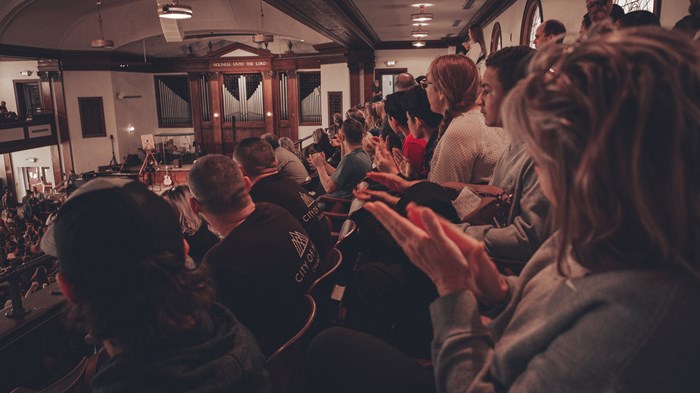
Image: Asbury University
The shofars didn’t start until Saturday. With them came the would-be prophets seeking to take center stage at the Asbury University chapel where students had been praying and praising God since Wednesday morning; the would-be leaders who wanted to claim the revival for their ministries, their agendas, and celebrity; and the would-be disrupters, coming to break up whatever was happening at the small Christian school in Kentucky with heckling, harangues, and worse.
But by Saturday, Asbury University was ready.
The school had not planned an outpouring of the Spirit. But when something started to happen in the middle of the first week of February—the middle of the semester, a few days before the Super Bowl—an impromptu mix of administrators, staff, faculty, friends, and university neighbors quickly mobilized. They gathered in a storage closet off the side of Hughes Auditorium and then repurposed a classroom to facilitate and support whatever it was that God was doing.
As word spread, the crowds came, and debates raged online about whether this was a “real” revival, these men and women worked untold hours to make sure that everyone who sought God had food and water and restrooms and everyone was safe. Part of the story behind the story of the revival is the almost invisible work that went into protecting it.
“There were 100 people volunteering at any one time, just to make these services work on the fly,” Asbury University president Kevin Brown told CT. “There was a classroom that got redeployed into almost a command center. If you walked in, there were flow charts on the wall and the whiteboards were covered with information. There was a volunteer check-in station. … It was one of the most impressive technical feats I’ve ever seen.”
The revival began at a chapel service on February 8. Zach Meerkreebs, the assistant soccer coach who is also the leadership development coordinator for the missions organization Envision, preached about becoming love in action. His text was Romans 12.
As he started, Meerkreebs told the students, who are required to attend three chapels per week, that he wasn’t aiming to entertain them. And he didn’t want them to focus on him.
“I hope you guys forget me but anything from the Holy Spirit and God’s Word would find fertile ground in your hearts and produce fruit,” he said. “Romans 12. That’s the star, okay? God’s Word and Jesus and the Holy Spirit moving in our midst, that’s what we’re hoping for.”
Meerkreebs also talked to them about the experience of God’s love, in contrast to the “radically poor love” that’s narcissistic, abusive, manipulative, and selfish.
“Some of you guys have experienced that love in the church,” he said. “Maybe it’s not violent, maybe it’s not molestation, it’s not taken advantage of—but it feels like someone has pulled a fast one on you.”
No one came forward at the end of the service, though, and Meerkreeb was convinced he “totally whiffed.” He texted his wife: “Latest stinker. I’ll be home soon.”
A Black gospel trio sang a final song and chapel ended—but 18 or 19 students stayed. They sat in several clusters: a few along the right wall, a few in their seats, a few on the floor in the aisle, a few at the foot of the stage. They kept praying.
Zeke Atha, a junior, told a documentarian a few days later that he was one of the ones who remained in the chapel. He left after an hour to go to a class, but then when he got out, he heard singing.
“I said, ‘Okay, that’s weird,’” Atha said. “I went back up, and it was surreal. The peace that was in the room was unexplainable.”
He and a few friends immediately left, sprinting around campus, bursting into classrooms with an announcement: “Revival is happening.”
The Wesleyan-movement school has a tradition of revivals and a theology that teaches people to wait and watch for a divine wind to blow. The university is named for Francis Asbury, the early American Methodist bishop who encouraged and celebrated revivals from Maine to Georgia and Maryland to Tennessee.
There are also people in the Kentucky community who have long prayed for fresh revival at the school, including a Malaysian theology teacher who sometimes walked the streets with a cardboard sign that said, “Holy Spirit, You Are Welcome Here.”
Administrators, however, did not immediately assume a revival was starting, even as young men ran around campus shouting it was. Only as the spontaneous prayer service stretched into the afternoon and then evening did school officials realize they might have to make a decision about how to respond.
Meeting in a closet
An ad hoc revival committee of about seven people gathered in the one quiet space in Hughes—a storage closet. According to several people who were there, they pushed aside a drum kit and keyboard and sat knee to knee. Someone found a dry erase board, and they asked each other, “What are we going to do in the next two hours?”
Then they started thinking slightly longer term: “Will students stay all night? What does that look like? Should we leave the sound system on? Should we let students keep bringing guitars into chapel?”
The group decided to have ministers stay in Hughes and have security watch the building but keep it open. They would let the students stay and pray and sing as long as they wanted.
Other decisions they made in the next few days seem, as the ad hoc committee reflects on them now, almost like they happened by instinct. There was no time for drawn-out discussions. They would meet in the storage closet and make decisions minute by minute. Did they want to put up screens for the lyrics of the worship songs? No. Should ministers who spoke on stage stop to introduce themselves? No. Should they put up signs asking people not to livestream? Yes.
“We were just trying to keep up,” student life vice president Sarah Thomas Baldwin told CT. “There are people and they’re showing up and they’re desperate for God. We’re just trying to stay alive and trying to honor what is happening.”
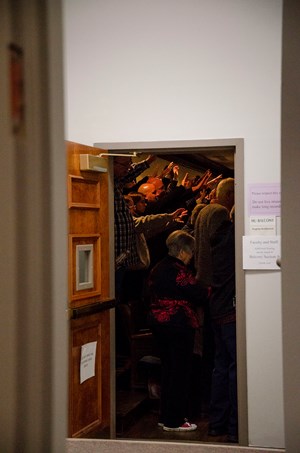
Image: Lisa Weaver Swartz
By the second day, word had spread to the seminary, about a football field away, which shares a namesake and tradition but is a separate institution. People started to come from the town of Wilmore too and then the greater Lexington area.
Alexandra Presta, editor of the student newspaper, posted a report online.
“During a call of confession, at least a hundred people fell to their knees and bowed at the altar,” she wrote. “Hands rested on shoulders, linking individual people together to represent the Body of Christ truly. Cries of addiction, pride, fear, anger and bitterness sounded, each followed by a life-changing proclamation: ‘Christ forgives you.’”
Friends from other states started texting Presta, asking her what was happening and also why. She told them she didn’t know. But God still moves.
‘All the Chick-fil-A’
On Friday afternoon, groups of students started to show up from other parts of Kentucky, as well as Tennessee, Ohio, Indiana, even Michigan. Some came from Christian schools. Some from campus ministries. Some just came.
By evening the crowd had grown to about 3,000, and the university had to set up overflow rooms. At the same time, an uncoordinated infrastructure of support began to appear. An Asbury student set up a table and started handing out tea and coffee. She said Jesus told her to. A woman in Indianapolis baked chocolate chip cookies for a full day and then drove down to give them away. A professor went and got cases of bottled water.
Severe oxygen shortage one of many challenges as India suffers the world’s worst surge of COVID-19 cases and deaths.
CHRISTINA MARTIN AND THE ASSOCIATED PRESS|
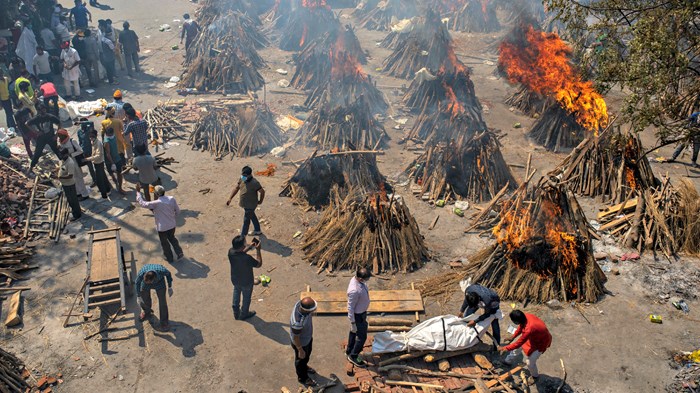
Image: Altaf Qadri / AP PhotoMultiple funeral pyres of Indian victims of COVID-19 burn in a New Delhi area converted for mass cremation on April 24.
With life-saving oxygen in short supply, families are left on their own to ferry people sick with COVID-19 from hospital to hospital in search of treatment as India is engulfed in a devastating surge of infections. Too often, their efforts end in mourning.
India has been setting global daily records of new coronavirus infections, spurred by an insidious new variant that emerged here.
On Friday, the number of new confirmed cases breached 400,000 for the third time since the devastating surge began last month. The 414,188 new cases pushed India’s official tally to more than 21.4 million, behind only the United States.
The Health Ministry also reported 3,915 new deaths on Friday, bringing the confirmed total over 234,000 (behind only the US and Brazil). Health experts believe both figures are an undercount.
Leaders of Christian churches and ministries in India have been overwhelmed by cases and deaths among their staff and congregants amid the unavailability of treatment. In response, today was jointly declared a day of prayer and fasting by the leaders of the Evangelical Fellowship of India (EFI), the National Council of Churches in India (NCCI), and the Catholic Bishops’ Conference of India (CBCI).
The current crisis is one of the darkest times in the history of the nation, according to Prabhu Singh, principal of the South Asia Institute of Advanced Christian Studies (SAIACS), an evangelical research institution in Bengaluru.
“One of the heartbreaking results of this intense second wave in the country is the tragic loss of senior leaders of Christian organizations and seminaries as well as church pastors and lay leaders,” he told CT. “The other leaders are also experiencing severe strain as they struggle to cope with the impact of the pandemic.”
“We estimate 350 to 400 pastors, evangelists, and bishops have lost their lives—and that is a conservative figure,” said Vijayesh Lal, general secretary of EFI, citing tallies in Maharashtra, Gujarat, Delhi, and other states.
“The church has lost a lot of leadership,” he told CT. “And when you consider that it takes time and effort to build up leadership, I believe we are headed for a leadership vacuum.”
 Dr. Bryan E. Galloway
 Pray for Revival!
Recent Comments